How to Cite ChatGPT & AI Tools in MLA Format
Learn how to cite ChatGPT and generative AI tools in MLA 9 format. Step-by-step instructions for Works Cited entries, in-text citations, and AI disclosure.
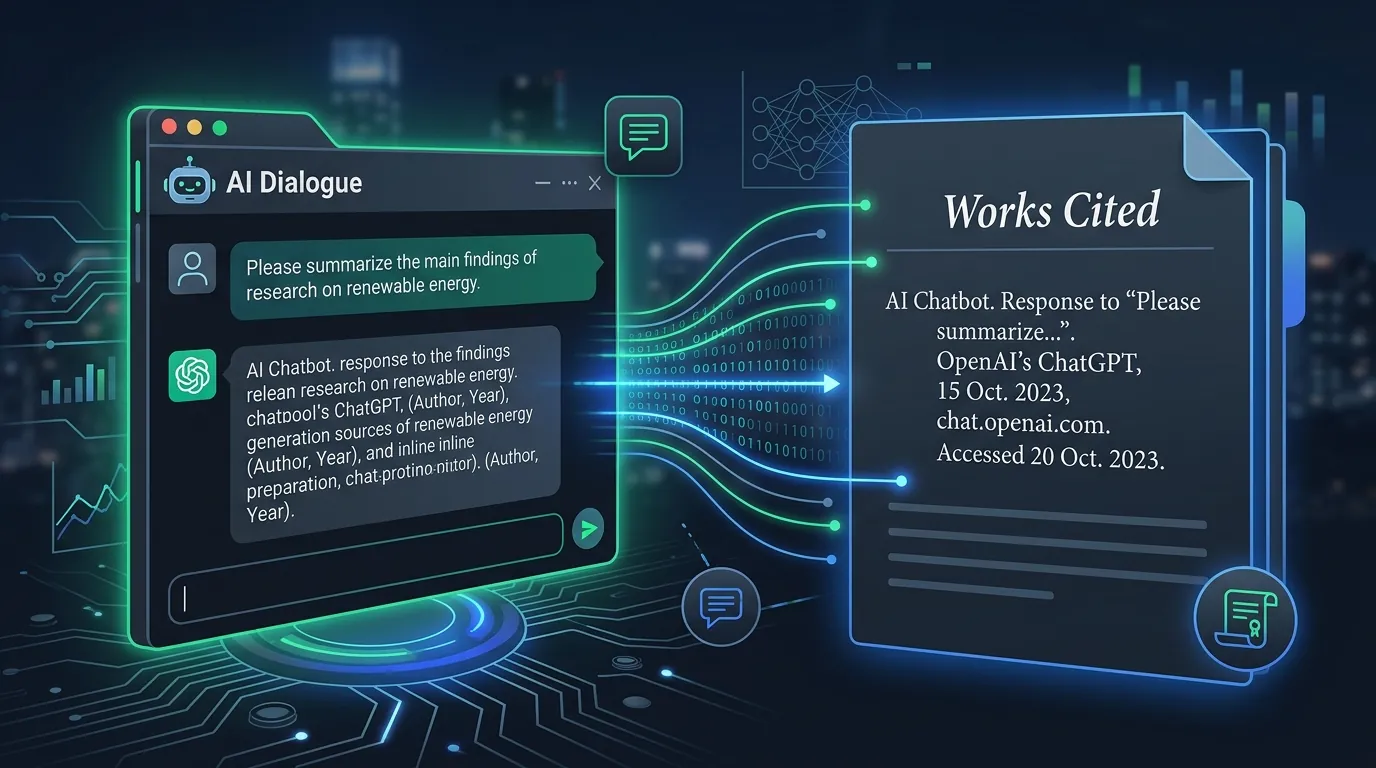
AI tools now sit beside notebooks and textbooks. You might ask ChatGPT to explain a topic or brainstorm ideas. But when that output shapes your paper, you need a proper ChatGPT citation. This guide shows how to cite ChatGPT in MLA step by step. You’ll also learn how to cite AI in MLA format for other tools and how to disclose AI use honestly.
What Does MLA Say About Citing AI-Generated Content?
The MLA released guidance on this in 2023. It says you should cite an AI tool whenever you “paraphrase, quote, or incorporate” its content. These MLA AI guidelines shape every generative AI citation you write today.
The key rule is simple. Don’t treat the AI as an author. The MLA also suggests acknowledging other uses, like editing help, in a note. It advises checking any sources an AI mentions too. These MLA rules for AI citations support AI academic integrity in every class.
How Should You Identify ChatGPT in an MLA Citation?
ChatGPT goes in the container slot, written in italics. Next comes the version, then OpenAI as the publisher. This is the core of any ChatGPT MLA citation or OpenAI citation.
The title slot describes your AI prompt. Put that description in quotation marks. So the entry starts with your question, not with “ChatGPT.” Knowing this helps you cite ChatGPT in MLA 9 and avoid the most common chatbot citation mistake.
What Information Should Be Included When Citing an AI Tool?
Every AI tool citation uses MLA’s core elements. The table below shows how each one works for an artificial intelligence citation.
| MLA Element | What to Include | Example |
|---|---|---|
| Title of source | AI source description or prompt | ”Summarize the causes of the Dust Bowl” prompt |
| Container | AI tool name | ChatGPT |
| Version | AI model name | GPT-4o version |
| Publisher | AI publication information | OpenAI |
| Date | Date of the generated response | 14 Sept. 2026 |
| Location | Shared link or tool address | [shared chat link] |
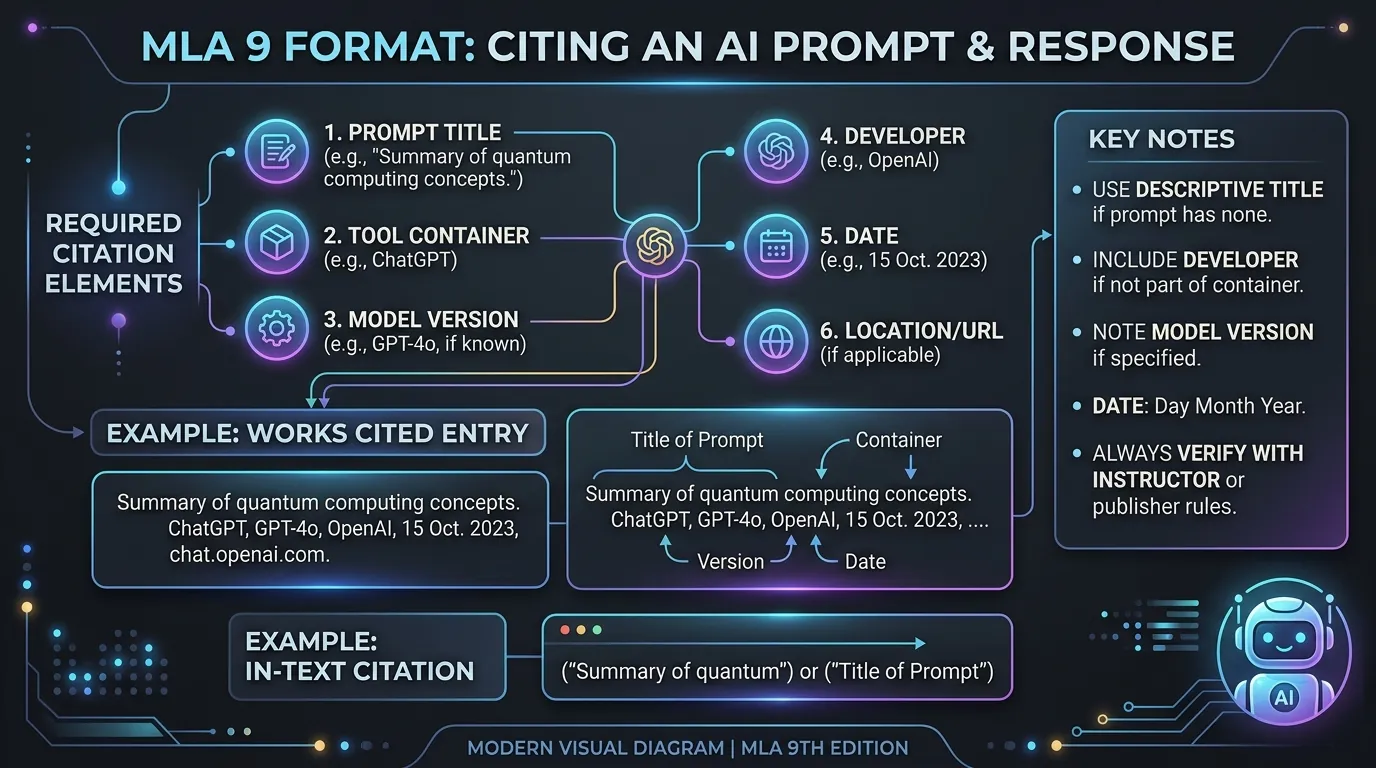
MLA AI Citation Example for a ChatGPT Works Cited Entry
Here’s a full ChatGPT Works Cited entry you can model:
“Summarize the causes of the Dust Bowl” prompt. ChatGPT, GPT-4o version, OpenAI, 14 Sept. 2026, [shared chat link].
This MLA AI citation example shows exactly how to add ChatGPT to Works Cited. Keep it handy with your other AI citation examples.
How Can You Document an AI Conversation or Generated Response?
Save the AI conversation before you close the window. Many tools offer a share link. Screenshots and copied transcripts also work well. This prompt documentation helps you cite an AI conversation in MLA later.
Record the date, tool, and version as well. Store everything in one folder. Good AI documentation practices make your AI source documentation easy to check. They also help if a teacher asks to see your full chatbot conversation.
What Is the Difference Between Citing AI Output and Citing a Source Found Through AI?
These are two different things. If you use the AI’s own words or ideas, cite the AI. That’s an AI response citation, and it covers the AI output itself.
But if the AI points you to a book or article, find that source yourself. Read it, then cite the original. AI tools sometimes invent sources that don’t exist. So never copy a ChatGPT reference list blindly. This habit sits at the heart of AI research ethics and responsible AI citation.
How Should AI Use Be Acknowledged in an Academic Assignment?
Follow your instructor first. Every school has its own academic AI policy. Some ban AI tools completely. Others allow AI-assisted writing with a clear AI disclosure. Always read the syllabus closely.
A short note is often enough. For example: “I used ChatGPT to brainstorm topic ideas. All writing and analysis are my own.” This is how to acknowledge ChatGPT in an essay and how to document AI use. It builds AI transparency and shows ChatGPT academic use done right.
What AI Citation Details Can Change Depending on the Tool Used?
The publisher changes with each tool. Google makes Gemini. Anthropic makes Claude. Microsoft makes Copilot. Version names differ too, so check each tool’s settings or help page.
Location details also vary. Some tools create share links, while others don’t. When no link exists, use the tool’s main web address. These differences matter for any large language model citation or LLM citation. They also shape how you cite AI tools in academic writing.
How Do You Handle AI Responses That Cannot Be Reproduced Exactly?
AI answers change constantly. The same prompt can produce different text tomorrow. That’s why the date matters so much in MLA documentation AI entries.
Save a copy of the AI-generated response right away. Some instructors even ask for the full transcript in an appendix. This protects your AI output attribution. It also helps you cite an AI-generated response accurately, even when the tool can’t repeat it.
What Should You Check When an AI Citation Generator Produces an Unclear Reference?
Some generators still list “ChatGPT” as the author. Others skip the prompt or version entirely. Fix these right away. Also confirm that the date matches your actual session.
Watch for vague links and missing italics as well. Case study: Picture a history student who pastes a generated entry listing “OpenAI” as the author. A quick look at MLA guidance shows the prompt should come first. This fast review is how you check ChatGPT citation format before submitting.
How to Create an AI In-Text Citation in MLA
Your AI in-text citation uses a shortened prompt title. For example, write (“Summarize the causes”). It must match the first words of your AI Works Cited entry. This keeps your AI attribution clear and simple to trace.
Conclusion
Before you submit, review every AI entry carefully. Start with the prompt, not the tool. Then add the tool name, version, publisher, date, and location. Save the conversation, and follow your class policy on AI writing disclosure. Finally, verify any sources the AI suggested. With these steps, you’ll know how to cite ChatGPT in MLA and document ChatGPT use in MLA with confidence.