MLA In-Text Citations: Tricky Edge Cases Explained
Master complex MLA in-text citation edge cases: multiple authors, same author works, corporate authors, unpaginated sources, and block quotes.
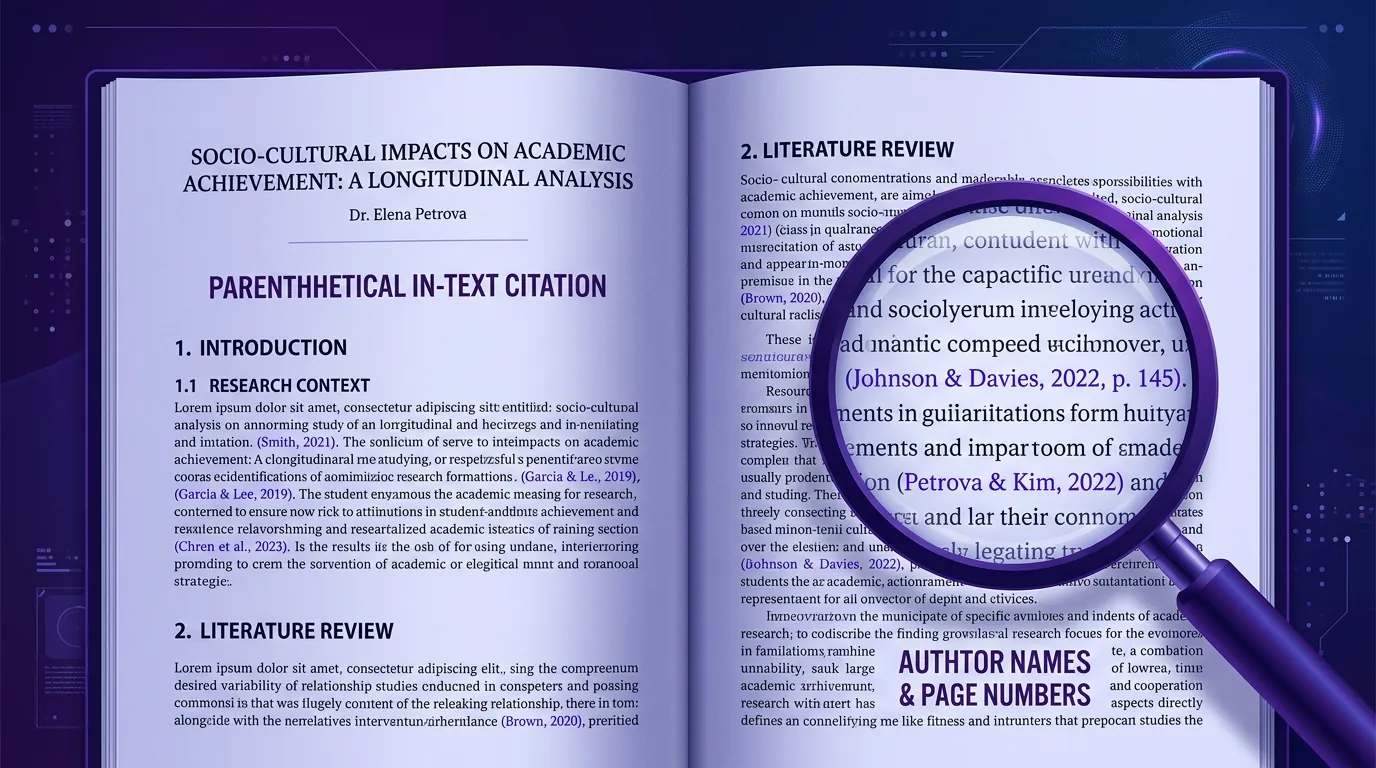
Most citation tools handle simple cases well. One author plus one page number is easy. Real research gets messy, though. You’ll meet sources with three authors, no author, or no page numbers at all. This guide covers the MLA in-text citation edge cases that generators quietly skip. You’ll learn how to create MLA in-text citations that stay clear, correct, and easy to trace.
What Makes an MLA In-Text Citation an Edge Case?
A basic MLA parenthetical citation shows the author’s last name and a page number, like (Rivera 22). An edge case breaks this pattern. Maybe there’s no author. Maybe two sources share a surname.
Generators mostly build Works Cited entries. They rarely explain parenthetical references inside your paragraphs. So you must handle these MLA citation exceptions yourself. The goal never changes, however. Readers must find the matching entry in seconds.
How Do You Cite Sources With Multiple Authors in Text?
For two authors, list both last names joined by “and.” For three or more, use the first name plus “et al.” These MLA citation rules keep your sentences short and readable.
| Number of Authors | In-Text Example |
|---|---|
| One author | (Rivera 22) |
| Two authors | (Rivera and Chen 22) |
| Three or more authors | (Rivera et al. 22) |
| Group author | (National Park Service 14) |
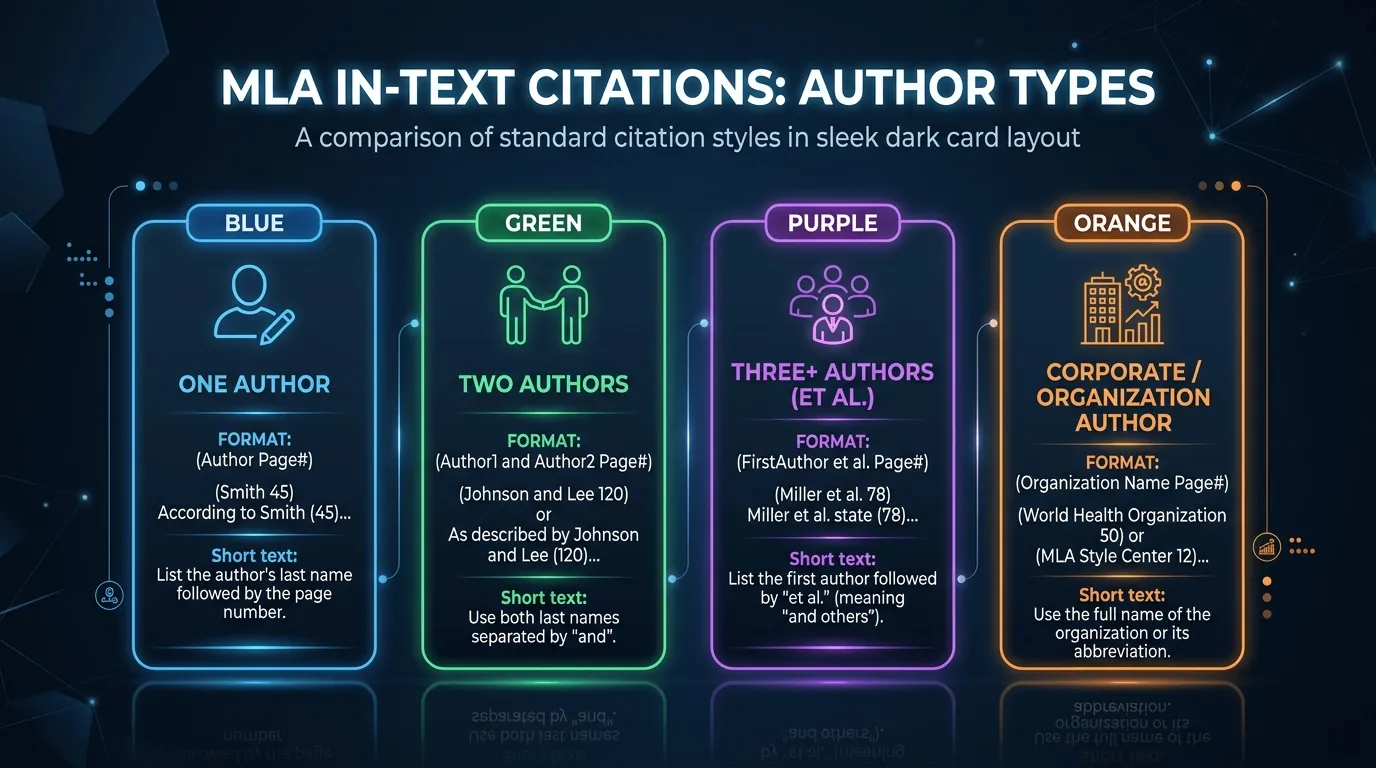
This table shows how to cite multiple authors in MLA at a glance.
What Happens When a Source Has No Named Author?
Use a shortened title instead. Put article titles in quotation marks. Put book and website titles in italics. For example, write (“Rising Sea Levels” 3). That’s the standard MLA citation with no author.
Keep the short title to its first noun phrase. It must match the start of the Works Cited entry. This rule also covers anonymous sources. It’s the simplest way to handle an MLA citation when author is unknown.
How Should You Handle Multiple Works by the Same Author?
Add a shortened title after the name, with a comma between them. For example: (Morrison, Beloved 45). This tells readers exactly which book you mean.
If you name the author in your sentence, include only the title and page. For example: Morrison shows this in Beloved (45). This is how to cite two works by same author MLA style. It prevents citation ambiguity with repeated authors.
What Changes When Different Sources Have Similar Author Names?
Two authors may share a last name. In that case, add first initials, like (J. Lee 8) and (M. Lee 12). If the initials also match, write out full first names.
This small change keeps your source identification crystal clear. Generators rarely catch same-name authors, so scan your list by hand. It’s an easy way to distinguish sources in MLA.
How Do Quotations and Paraphrases Affect MLA In-Text Citations?
Both need citations. Many students forget that paraphrases count too. If the idea came from a source, cite it. This rule covers how to cite a paraphrase in MLA.
For a direct quotation, the citation follows the closing quotation mark. The period comes after the parentheses. For a block quotation longer than four lines, the period comes before the citation. These MLA punctuation details shape correct citation placement.
How to Cite a Quotation in MLA Correctly
Here’s a short quotation example. Rivera argues that coastal towns face “hard choices” (22). For a block quotation, indent the entire passage half an inch. Then place the citation after the final period. This keeps short quotations and block quotations consistent throughout your paper.
What Happens When a Source Has No Page Numbers?
Many websites and ebooks lack page numbers. Don’t invent them. Simply cite the author, like (Patel). That’s how to cite a source with no page numbers.
If the source numbers its own paragraphs, sections, or chapters, you may use those. Write (Patel, par. 4) or (Patel, ch. 2). For videos and podcasts, use a timestamp citation, like (Patel 00:03:15–00:03:40). This guidance handles almost every unpaginated source.
How Can You Distinguish Between Sources With Similar Titles?
Sometimes two shortened titles look nearly identical. Picture “Climate Change Effects” and “Climate Change Solutions.” Shortening both to “Climate Change” creates confusion.
Add one more word to each short title. Write (“Climate Change Effects”) and (“Climate Change Solutions”). This small fix helps you cite sources with similar titles. It also keeps citation clarity strong when you face duplicate titles.
What Should You Do With Unusual Sources That Citation Generators Interpret Poorly?
Generators struggle with plays, poems, sacred texts, and social media. For verse plays, use act, scene, and line numbers, like (Hamlet 3.1.56). For poems, cite line numbers and write “lines” the first time.
For social media, the account name often serves as the author. Case study: Picture a sophomore citing a museum’s post. Her generator lists the platform as the author. She fixes it by using the museum’s account name instead. That’s how to handle unusual MLA sources and any complex source citation.
Using Shortened Titles in MLA for Unusual Sources
Short forms also help with corporate authors that have long names. You may shorten “United States Department of Agriculture” when the meaning stays clear. Just make sure the short form still matches your entry. This is how to use shortened titles in MLA without confusing readers.
Conclusion
Before you submit, read every in-text reference one more time. Does each one match its Works Cited entry? Did you add initials for same-name authors? Did you avoid invented page numbers? Did you place periods correctly around quotations? These quick questions help you check an MLA in-text citation and keep your parenthetical documentation clean, clear, and ready for grading.